Finding a voice
From the Peep Learning Together Programme – supporting parents and children to learn together through play and everyday life
Babies often make funny little sounds – you may have heard them shriek, babble, whoop, coo or gurgle! This is all part of trying out their voices and they love to experiment with sounds – especially when others respond. This is how they practise the more complex sounds they will need for talking.
Developing mouth muscles
Babies need to control lots of tiny muscles in their mouth and tongue before they can talk. They need to learn how to make the different shapes with their mouth and tongue that will help them to create the variety of sounds they will use to form words later on.
You may have noticed your baby exploring their mouth muscles when they lick their lips, suck, chew, stick their tongue out or blow bubbles – they may even use them to blow raspberries at you! Using their mouth and tongue in this way is really important for developing these tiny muscles and babies need lots of practice.
When you respond positively to the sounds and facial expressions that your baby makes, it lets them know that they are loved and that you are listening to them. This encourages them to explore their voices even more – which helps them gain control of the muscles needed for speech.
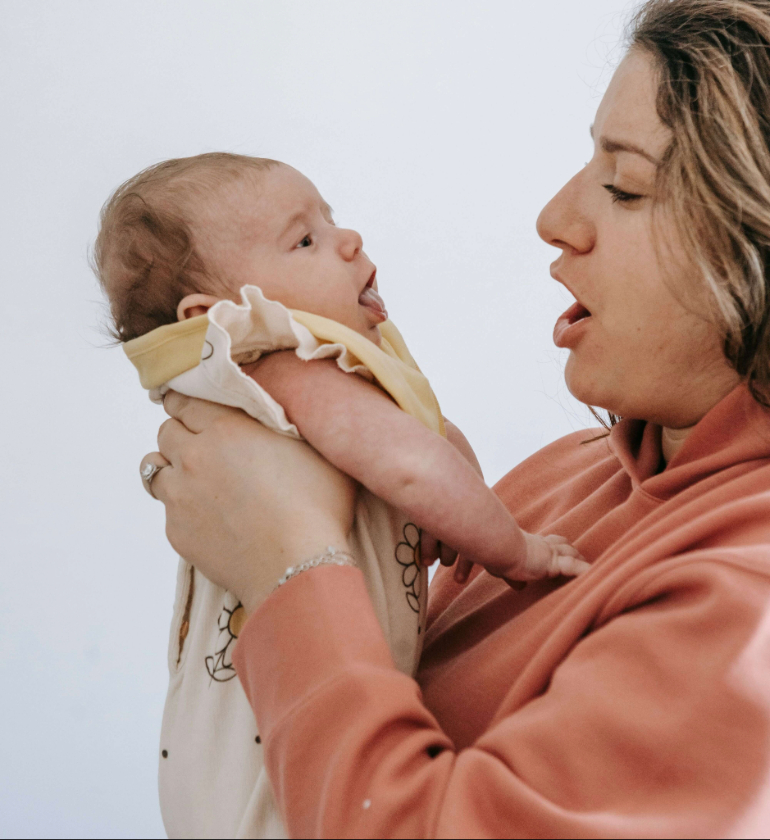
Try making different sounds for your baby and let them watch your face as they listen to you, e.g. “eeeee”, “shhhh”, “cooo”, “arrrrr” etc. You’ll probably feel your own mouth muscles being exercised as you make the sounds! Watch for your baby’s responses and give them time to answer in their own way.
Babies need to control lots of tiny muscles in their mouth and tongue before they can talk
Beginning to babble
Babies need to hear lots of talking and practise making lots of sounds before they will be ready to use words
From around six months, your baby may start to babble. You’ll hear them discovering all the different sounds they can make using their tongue, teeth, mouth and vocal cords.
To begin with, these might be simple sounds like “ba-ba”, “da-da”, “ma-ma”. As they grow and practise, these sounds become more complex, e.g. “dagoo”, “badadoo”.
Babies babble in the same way all over the world, and by listening very carefully you can hear sounds used in many different languages. At about nine months, the sounds that babies use begin to narrow down to those they hear daily in the language(s) spoken around them.
Mother tongue
Babies are able to hear sounds when they are still in the womb. For quite a while now, your baby has been listening to the rhythm and sound patterns of the language you are most familiar and comfortable using at home and on a daily basis. This language is often referred to as the ‘mother tongue’, and it is the language that your baby will hear, learn and begin to use. Being familiar with your mother tongue makes it much easier for babies to learn other languages later.
Crying to communicate
Tuning in to your baby’s cries, expressions and responses can help you to work out how they might be feeling
Babies often cry when they are born – this is usually a sound we are pleased to hear!
As babies change and develop from month to month, their patterns of crying, sleeping and feeding alter. They are learning how to express a range of emotions and can be quite vocal in getting their message across.
Sometimes they may seem to be crying all the time, and sometimes it can be hard to understand why – some babies seem to cry for no apparent reason at all.
Crying is one way that your baby can let you know that they need something. As you and your baby get to know each other, you will become more familiar with your baby’s responses and the sound of their cries. As time passes, you can start to recognise the differences between hunger, pain, fear, boredom, frustration and generally feeling out of sorts.
Try listening and watching your baby closely:
- Listen out for different types of crying
- Watch your baby’s facial expressions, gestures and movements – pulling their knees up to their chest can sometimes mean they have a tummy ache
- Think about why they might be crying – could it be that they have a dirty nappy? Or are hungry, tired, fearful or bored?

Coping with crying
When your baby seems unable to accept comfort and cuddles or food and attention, it can be very upsetting and frustrating. Babies are very sensitive to stress and tension in voices, hands and bodies, which doesn’t help.
You might find the following ideas useful, but remember to always seek professional help if you think you or your baby needs it.
- Sing softly to your baby or give them a gentle massage – this can be a soothing experience for your baby and it can help to calm your feelings too.
- Go outside – babies often enjoy fresh air and the different sights and sounds around them. This can bring a welcome change of scenery for you both.
- Be kind to yourself – ask for help to look after your baby so that you can recharge your batteries. This also gives others the opportunity to get to know your baby too.
Your feelings for your baby can be very mixed. Rather than struggle against negative feelings on your own, it may help you and your baby to share these feelings with your partner, another parent, friend or relative. You may well find you are not the only one!
It can help to remember that as you get to know your baby, understanding and love will grow for both of you.
As you get to know your baby, understanding and love will grow for both of you

Peep programmes and resources
The information on this page is from our Peep Learning Together Programme. In Peep sessions, families share song and storytime, play activities and conversations focusing on supporting babies’ and children’s development through play and everyday life.
Peep builds on the things you’re already doing with your child, making the most of everyday moments to learn together, have fun and strengthen relationships.
If you’re a parent or carer:
If you work with families:
This resource is one of a selection from the Peep Learning Together Programme shared in support of the Learners from Birth initiative.
Ages and stages: We recognise that children are all different, and developmental needs and interests don’t always align with a child’s age. Any ages mentioned are a general guide – the resources are for using flexibly to meet individual children’s needs and interests.