Making sense of sounds
From the Peep Learning Together Programme – supporting parents and children to learn together through play and everyday life
Babies and young children make sense of sounds by being able to hear and see who (or what) is making them.
In a world that is often full of noises and distractions, opportunities to watch and listen carefully help babies and young children to separate sounds and make sense of them.
Beginning to listen
Babies begin to hear while they are still in the womb – their first sound is likely to have been the steady rhythm of their mother’s heartbeat. As they develop, they begin to hear external sounds such as voices, music and other noises – they will recognise the sound of familiar voices from birth! Listening to these sounds forms the very beginning of their awareness of communication and language.
Once they are born, babies are exposed to a flood of new and different sounds which they need help to make sense of.

Children need help sorting out sounds
Our noisy world
Being able to distinguish one sound from another is an important part of learning about spoken language and for being able to read and write later on
We live in an often busy and noisy world, surrounded by all kinds of sounds such as:
- household noises: hoover, washing machine, fridge, phones, television, music, electronic sounds from computers
- voices: people talking, humming, singing, shouting, whispering, laughing, singing – in real life and on the television or radio – and often all at once!
- music: of all kinds
- traffic: trains, cars, buses, lorries, airplanes, helicopters
- natural sounds: wind, rain, thunder, sea, birdsong, bees buzzing
- everyday sounds: footsteps, doors banging, water running, cooking sounds, cats
As adults, we can tell the differences between these sounds and recognise who (or what) is making them – babies and young children need to learn these things.
Quiet times
Very young children hear hundreds of noises every day – often several at a time. It can help babies and young children to focus on the sounds around them, and to listen carefully, if they are not distracted by lots of background noise.
Having quiet times together will give your baby/child the opportunity to listen closely to the sounds of spoken language in your voice, and to become familiar with the other sounds around them – like the wind in the trees or an aeroplane flying by.
Gradually children learn to hear the difference between one noise and another and to make sense of what each sound means
Seeing and hearing
Opportunities to watch and listen carefully help children to separate sounds and to make sense of them
It is really helpful for babies and young children to experience sounds by both hearing and seeing who (or what) is making them. Talking to them about what they can see and hear helps them connect sounds to the objects or animals that are making them.
Often, we talk with children about what they are seeing – ‘There’s a bus’, ‘Look at that car’, ‘That’s a dog’ – but not so much about what they are hearing. Talking to children about what they can hear as well as see will encourage them to listen carefully.
It is much easier to know the sound that a dog, a washing machine or the rain makes if you have experienced it as part of everyday life, in books, on television or when playing with toys!
The importance of separating sounds
When you help your child to listen carefully to everyday sounds, and to make sense of them, they are developing the skills that will help them to become readers and writers later on.
Having quiet times where they can listen carefully to your voice will help them to recognise the sounds that are required for spoken language. This will help them to understand speech – and be able to talk back!
Being able to distinguish one sound from another helps children to:
- notice and respond to occasional sounds – a plane flying past, a sudden gust of wind, an ambulance siren…
- recognise familiar voices – ‘That’s Daddy, I can hear him talking’
- pick out voices from a background of noise
- notice when sounds are similar – ‘The cat sounds like the baby when she cries’
- notice when sounds are different – ‘That’s not our phone, it has a different ring’.
Having quiet times where your baby or child can listen carefully to your voice will help them to recognise the sounds that they’ll need as they learn to talk
Helping to make sense of sounds
Here are some ways you can help your child make sense of sounds:
- have some quiet times to listen carefully to the noises all around you – cars or a train rumbling by, birds singing or the wind in the trees
- point out and talk about sounds and noises you hear around you every day – ‘That’s the washing machine finished… can you hear it beeping?’
- try to imitate the sound together – helicopters are very tricky!
- share books, songs and rhymes with sounds and noises
- make a ‘noise’ picture book to share
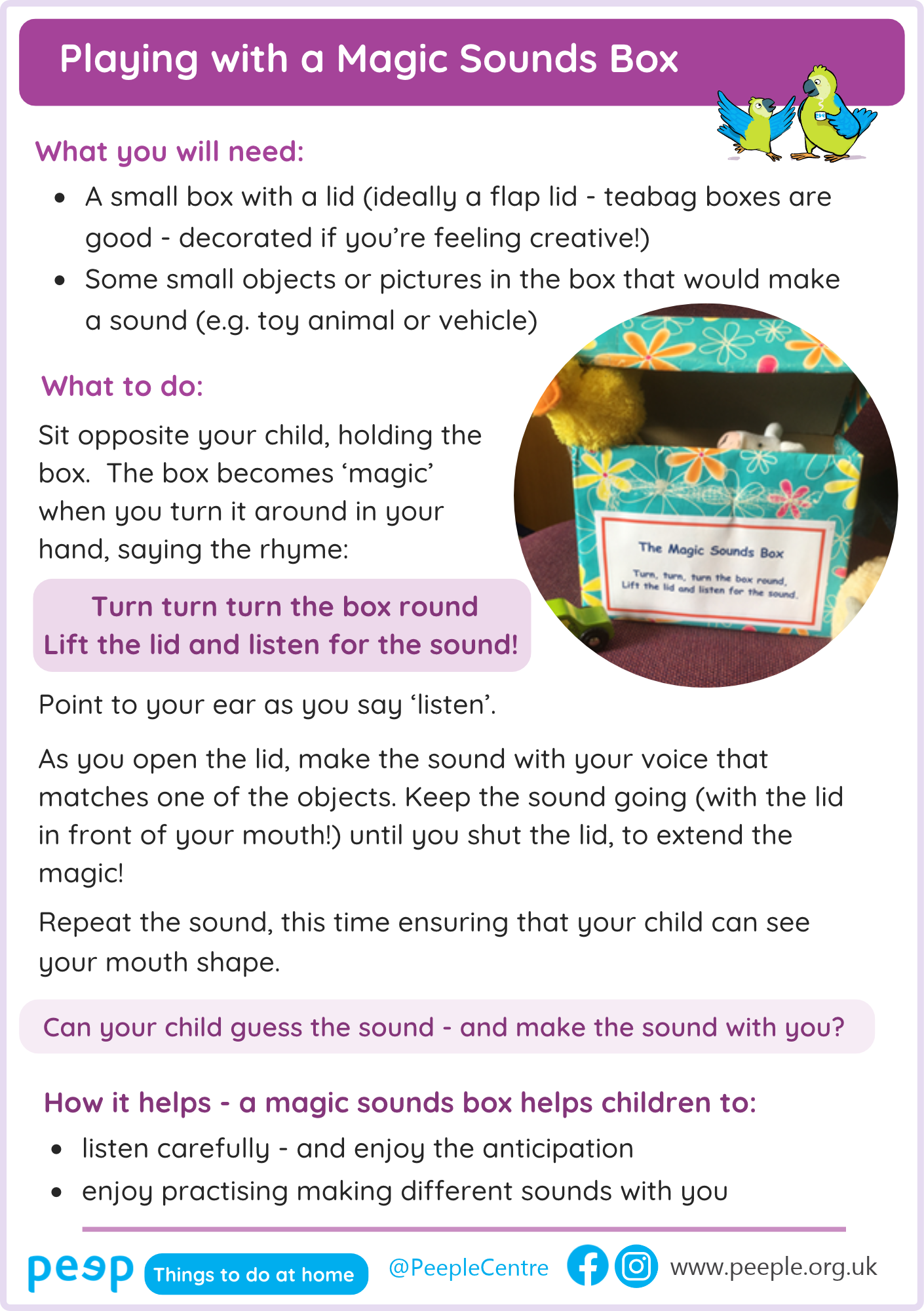
- make a Magic Sounds Box (see opposite/ below)
Peep programmes and resources
The information on this page is from our Peep Learning Together Programme. In Peep sessions, families share song and storytime, play activities and conversations focusing on supporting babies’ and children’s development through play and everyday life.
Peep builds on the things you’re already doing with your child, making the most of everyday moments to learn together, have fun and strengthen relationships.
If you’re a parent or carer:
If you work with families:
This resource is one of a selection from the Peep Learning Together Programme shared in support of the Learners from Birth initiative.
Ages and stages: We recognise that children are all different, and developmental needs and interests don’t always align with a child’s age. Any ages mentioned are a general guide – the resources are for using flexibly to meet individual children’s needs and interests.