
Room to Play was an innovative drop-in style provision in a community shopping centre, underpinned by the Peep ethos and programme. It aimed both to welcome and value all parents and carers, and to extend their existing parenting practices. Room to Play sought to appeal to ‘excluded’ or isolated families who, for a range of reasons, may not have accessed other services. The project was funded by the Sutton Trust and the Garfield Weston Foundation.
Peep stay and play sessions in a shopping centre
An independent evaluation of the project was carried out by the University of Oxford, in three phases. A brief summary or the full research report of the evaluation can be found below.
Several recent research studies point out that it is often the services themselves that inadvertently exclude families. As Oxford University’s evaluation (Evangelou, Smith, Coxon, Sylva, 2008) indicates, Room to Play has gone a long way towards overcoming these barriers and engaging with a wide cross section of families.
Room to Play had decreased [the mum’s] social isolation, and importantly, she had begun to interact more positively with her child, and was growing in confidence. She had made a treasure basket for her child and was beginning to use everyday objects such as wooden spoons in playing with her son.”
Room to Play Practitioner
Engaging families: Approaches used in Room to Play
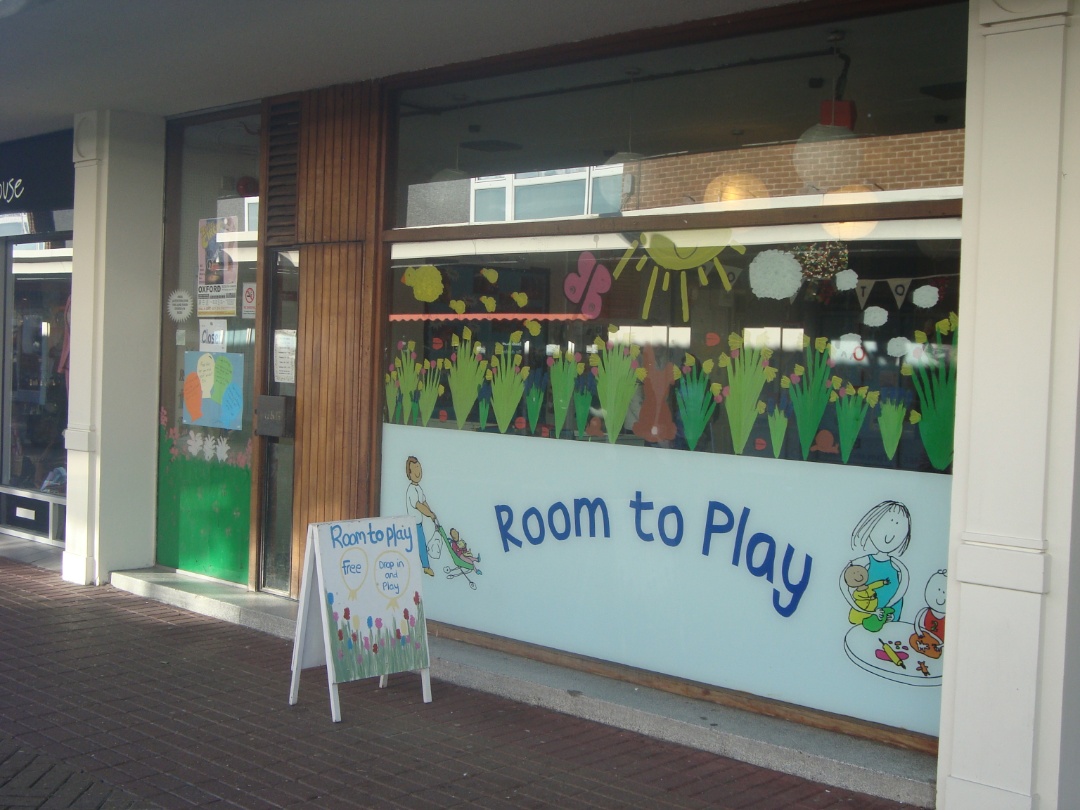
- Taking the service to the user, rather than expecting the user to come to the provider: Room to Play was based in a busy community shopping centre, and was open six days a week throughout the year.
- Effective engagement requires time, sensitivity and flexibility: relationship-building, friendship and social interaction were some of the successful ways of supporting parents and children. Staff also helped parents to ‘move on’ and access other provision.
- It is important to locate the service in attractive premises: parents said that they felt comfortable within the open-plan, home-from-home environment. They could relax with their child(ren), as well as joining in ‘messy play’ activities (such as painting, and playing with playdough, water, sand and ‘gloop’).
What the Room to Play study found
The study found that the way a service is designed can have a major influence on which families use it. Rather than expecting parents to attend a traditional service, Room to Play was based in a busy community shopping centre and created a welcoming, informal environment where families could drop in when it suited them. The evaluation found that this approach successfully engaged a broad cross-section of families, including many who might not otherwise have accessed family support services.
The study also found that successful engagement depended on much more than location. Practitioners built trusting relationships over time through warmth, flexibility and genuine interest in parents and children. Families valued the relaxed atmosphere, opportunities to meet other parents and the chance to explore play activities together without feeling judged or pressured.
The evaluation showed that high-quality learning opportunities can be offered within an informal, drop-in setting. Everyday play activities became opportunities for practitioners to share ideas about children’s learning and development, helping parents to recognise how simple interactions at home can support their child’s development.
The researchers also found that Room to Play often acted as a bridge to other services. As trust developed, practitioners were able to support families to access additional services and opportunities when appropriate, demonstrating the value of relationship-based practice in helping families become connected with wider community support.
What this means for practitioners working with families
The evaluation suggests that practitioners can:
- consider whether the location and style of a service genuinely make it easy for families to take part
- recognise that building trust takes time, consistency and genuine relationships
- create welcoming, informal environments where parents feel comfortable staying, talking and playing with their children
- use everyday play and conversations as opportunities to share ideas about children’s learning and development
- value peer support and friendships between parents as an important outcome in their own right
- help families make connections with other services when they are ready, using trusted relationships as a starting point
- remember that flexibility and responsiveness are often as important as the activities themselves in engaging families who may not usually access support.
Parent story from the research report
Although this study pre-dates Family Hubs, it provides a practical example of the kind of integrated support that they and similar community-based services seek to offer. This parent’s journey highlights how bringing together parenting support with advice and signposting on housing, benefits, childcare, training and employment can help families overcome challenges and thrive, while building their confidence, independence and parent support networks.
This young single parent had attended Room to Play since its first days as an open stall in the shopping centre. Initially, she was isolated as a new parent, with limited family support, and faced practical problems, for example with housing. Staff had initially helped her to access furniture and equipment as she moved into a council flat, and had also signposted her to further information about benefits. She had been able to use Room to Play’s phone for this. She also began to consult staff over concerns to do with her child, such as weaning, sleep patterns and behaviour problems. She had subsequently joined a Peep group and began to make things for her child such as mobiles and shakers.
Within Room to Play she made friends with other parents, particularly other young mothers. She had left school without qualifications but was keen to undertake further training and study. With the support of staff, outside of Room to Play she began to access careers advice as well as a training initiative for young mothers, and took part in a number of free courses from IT to basic first aid. She began to access other play opportunities for her child, for example, other family centres, and encouraged her friends to meet her there. Staff felt that they had provided a listening ear at the start, encouraging her to talk through her options for study and employment, and through these courses she had built up confidence.
She had also made friendships with other young parents in similar circumstances which had decreased her isolation. When she later attended a course which lasted a number of weeks, she sought advice from staff about childcare, and was able to find a childminder through Room to Play. In the early days, she visited every day: now her child attends nursery and she has a part-time job and attends once a week.”
Parent’s story told to research by the parent and practitioners
Find out more:
Peep-trained practitioners from any professional background can use the Learning Together programme with families in any context or setting. Follow the links for more information: