
The aim of the Time to Play project was to improve the integration of young children of ethnic minority (particularly Muslim) families, into the services offered by Children’s Centres. The project developed culturally appropriate approaches for mother and child sessions, based on creative play as a foundation for learning. These approaches fostered communication, self-esteem, language and creativity, and built on successful practice evolved through Peep. Through participatory action research, the project arrived at recommendations for intercultural practice and materials that respect the mothers’ values and parenting styles, and support their children’s development in line with the Early Years Foundation Stage.
A collaborative, multi-cultural action research project with families in children’s centres
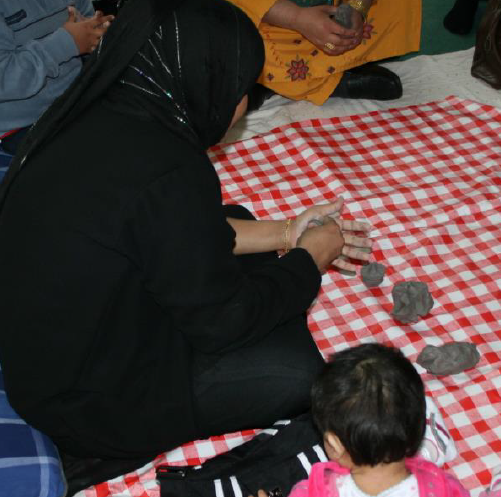
The Time to Play project was participatory in its approach. It involved parents in the design of what ‘works’ for them, as being culturally relevant and in tune with their aspirations, and in recognition of what they already do at home. It extended the Peep group provision by focusing on creative play for early learning within ethnic minority communities. These groups were based in Children’s Centres in Oxford, Bristol, Southampton and Birmingham, with a high proportion of Muslim families and different ethnic backgrounds in each city.
The project ran in three progressive phases: Consultation/information gathering; Development and delivery of approaches; Dissemination/sharing of what we learned. The work in this project also led to the production of a CD: Singing Together in Urdu and Punjabi.
What the project found
The Time to Play project found that creative play can be a powerful way to build relationships with families from different cultural and linguistic backgrounds when practitioners start by listening to parents’ own experiences, values and aspirations. Rather than assuming what families might want, the project explored parents’ views about play, music and learning, and used these conversations to shape activities that felt relevant and welcoming.
Many mothers already valued imaginative play and wanted the best educational opportunities for their children, but some were unfamiliar with the kinds of creative play commonly found in early years settings in England. The project showed that introducing new activities worked best when practitioners built on families’ existing strengths, interests and cultural traditions, rather than replacing them.
The action research also demonstrated that creative play can provide opportunities for conversation that extend beyond the activity itself. Through shared play, practitioners and parents developed trust, exchanged ideas about children’s learning and development, and gained a better understanding of one another’s experiences and perspectives.
Importantly, there was no single approach that worked for every family. Practitioners continually observed, reflected and adapted their sessions in response to parents’ interests, confidence and participation. This flexible, reflective way of working was a key factor in successfully engaging families from a wide range of backgrounds.
What this means for practitioners working with families
The project suggests that practitioners can:
- begin by finding out about families’ own play experiences, interests and hopes for their children
- introduce new play ideas gradually, linking them to activities that families already enjoy
- see parents as knowledgeable partners whose experiences and cultural traditions enrich the group
- use creative play to build trusting relationships as well as supporting children’s learning
- create a welcoming environment where parents can join in at their own pace
- reflect regularly on what is working and adapt activities in response to families, rather than following a fixed plan
- recognise that effective engagement depends on listening, flexibility and genuine curiosity about each family’s experiences.
Time to Play was managed from the Peeple Centre in Oxford, and the approaches were researched in partnership with Dr Susan Young from the University of Exeter, who has extensive experience of similar projects. You can read more in the Paper presented at the MERYC conference (Music Educators and Researchers of Young Children) by Dr Susan Young and Alison Street, linked below.
'Can parents open up their hearts with their children in any other language? ...' - an extract
‘Can parents open up their hearts with their children in any other language? Can they develop strong bonds with their children by discarding their home language? Can children express themselves easily to their mothers? And why do many children need to go to speech therapists?
Research shows that a child can hear parents’ voices even before birth. A child’s early years are extremely precious to their future growth in life, and their mother tongue plays a vital role in this. Children with a strong command of their home language can easily learn other languages.
Parents can help their children to know and understand the world by talking, listening, sharing stories and songs, and playing games in their own language. With the support of Peeple I have worked with parents on folk stories and lullabies, and shared that work with Punjabi mothers and children. I’m happy to say that the children and mothers who listened to these lullabies and stories together developed better communication and bonding among themselves and with the Punjabi language.’