
The research below demonstrates how parents and schools can work together to strengthen children’s learning and development at home and in school. The Families Connect programme was developed by Save the Children in 2014, and delivered by them for over ten years. We are delighted that they have entrusted Peeple with its future. The research studies discussed on this page were commissioned and carried out while Families Connect was under the Save the Children umbrella.
Development and Impact of Families Connect
After initial development of the Families Connect programme in 2014 various internal and external evaluations were conducted to examine the design and impact of the programme, each of which informed the overall evidence-based approach. Detail of the various evaluations and reports can be found below
Randomised Controlled Trial (RCT) of Families Connect
To build on the emerging evidence base from internal evaluations, Save the Children sought funding from the Nuffield Foundation to partner with NFER and Queen’s University Belfast to undertake an independent randomised controlled trial and implementation evaluation of Families Connect. This was designed to build on previous promising findings, to strengthen their understanding of the programme’s impact on parent and child outcomes and identify where the programme could be strengthened and improved, along with continual delivery feedback and review. The aim was to advance collective understanding, as a sector, of how best to support parental engagement and children’s early learning.
Thirty-one schools from disadvantaged areas across the UK (England, Wales, Northern Ireland and Scotland) delivered Families Connect as part of the independent evaluation. A total of 499 children aged four to six from 483 families took part.
The evaluation found that Families Connect had a positive impact on:
- the home learning environment: parents who had taken part in Families Connect reported engaging in more learning related activities with their children at home, than the parents of families who had not yet taken part
- parents’ self-efficacy, and parents feeling more confident and skilled with regards to supporting their children’s learning
- children’s prosocial behaviour and softer skills (e.g. dealing well with mistakes, getting on well with peers, adaptive to new tasks and challenges)
Save the Children produced a briefing document to accompany the full report, which provides an overview of the evaluation findings and sets out our approach for developing Families Connect and priorities for future research, policy and practice. Links to the reports are below.
Lord, P., Rennie, C., Smith, R., Gildea, A., Tang, S., Miani, G., Styles, B. and Bradley, C. (2020). Randomised Controlled Trial Evaluation of Families Connect. NFER, Slough.
Save the Children would like to thank the Nuffield Foundation and all those who conducted the evaluation and compiled the report at NFER and Queen’s University Belfast. The project has been funded by the Nuffield Foundation, but the views expressed are those of the authors and not necessarily the Foundation.
It has been great – has helped my child feel really settled in school and been a highlight of our week”
Families Connect Parent
“It helps me when I feel sad.”
Families Connect Child
Impact for families living with disadvantage
We were interested in exploring in more depth the relationship between social disadvantage and the parent and child outcomes of the programme. We expanded on the previous study by including a broader definition of social disadvantage and a wider range of outcomes to explore how the programme might be experienced differently by those living in social disadvantage.
This learning paper builds on our findings from the original evaluation, providing us with a more detailed understanding of the relationship between families living in social disadvantage and key outcomes of the Families Connect programme.
Some of the key findings include:
- Parent self-efficacy, their confidence and skills in supporting their children’s learning, are critical to supporting a positive home learning environment.
- Social disadvantage in general was found to negatively impact on children’s numeracy skills and families’ home learning environments.
- Families Connect was more impactful on the home learning environment (measured immediately after the programme) for families on lower incomes and those eligible for free school meals.
Sharing learning
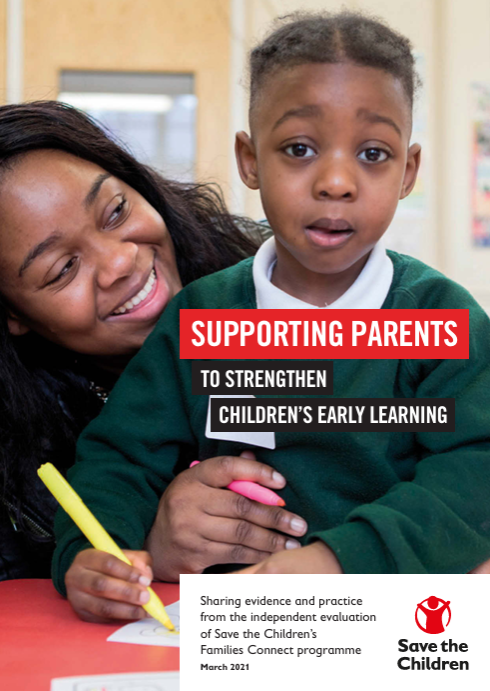
In 2021, Save the Children shared evidence and practice from the independent evaluation of the Families Connect programme, contributing to wider learning within the sector: ‘Supporting parents to strengthen children’s early learning’
It has given us lots of ideas to help us do learning at home”
Families Connect Parent
My child has made friends through attending Families Connect”
Families Connect Parent
Research reports
A great way of engaging children and their parents and involving parents in their children’s learning and development. I can see so much more confidence since attending Families Connect. Self-esteem has gone from strength to strength and so much happier since attending.”
Families Connect Class Teacher