
This case study shows how embedding the Peep Learning Together Programme can support a smooth transition from pre-school to reception and significantly improve outcomes for children and families. Delivered by early years staff, weekly Peep sessions strengthen home-school links, boost parental confidence, and enhance children’s learning and development – particularly for those eligible for Early Years Pupil Premium. The school has seen a marked increase in children achieving a Good Level of Development, making Peep a valued part of their approach to closing the attainment gap.
How Peep is offered
The school and its major feeder pre-school invited all parents whose children were due to start at the school in September, to attend a Transition Peep group of six weekly sessions during June and July. The school’s reception class Learning and Support Assistant (LSA) planned and delivered these sessions. The main feeder Pre-school used their existing relationships with families to help the school staff and families get to know each other more quickly. So many families wanted to attend that three groups were held.
Weekly Peep sessions sometimes continue in the autumn term, with new parents also being invited to join. The practitioner selects from the Peep topics, weaving in the Characteristics of Effective Learning, what will be happening during the school day, and how parents can support this. The Peep Learning Together Programme (LTP) complements the Early Years Foundation Stage, with the LTP’s five strands focusing on Personal, Social and Emotional Development, Communication and Language, Early Literacy, Early Maths, and Health and Physical Development.
This year coming to Peep has helped me engage with my child through a way of learning I wouldn’t have even thought of. New techniques and ideas to make learning fun!”
Peep parent
It’s great to see parents blossom and become more confident as they realise that everything they do in normal life contributes to their child’s learning. Listening to parents about what they need help with meant that I broke down barriers and ensured that they were able to understand how to support their child’s learning in a specific way.”
Learning Support Assistant/ Peep practitioner
Outcomes for children, families and the school
1. Improved relationships between school and families
I was able to ask questions without feeling silly.”
Peep Parent
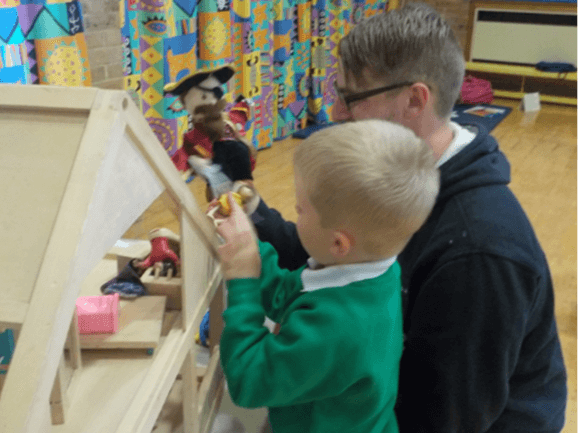
The Peep sessions improve families’ transition into the school: Peep children settle in particularly quickly, and both parents and children develop friendships and are comfortable with the adults in the school. By the end of the school year about 70% of families have attended Peep sessions.
In the words of the head teacher: “The Peep programme provides a good opportunity for parents/carers and children to work alongside trained staff to enhance learning opportunities. The parents involved feel more confident in how to support their children, and the children benefit from activities designed to build upon their skills.”
2. Parents are more knowledgeable about the value of the home learning environment
This year coming to Peep has helped me engage with my child through a way of learning I wouldn’t have even thought of. New techniques and ideas to make learning fun!”
Peep Parent
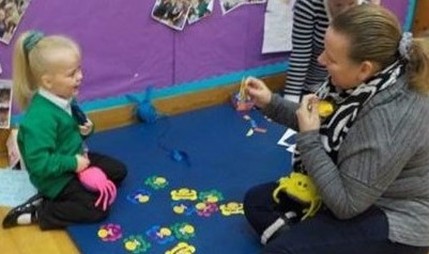
Parents learn more about how to support their children’s learning, by building on all the valuable things they already do. They spoke about how they looked forward to the Peep group, and were continuing to do the learning and play ideas from the sessions at home.
3. Improved outcomes for children
Outcomes at the end of the year identified that 73% of children who regularly attended Peep sessions attained their Good Level of Development (GLD – the government’s measure of five year old’s attainment at the end of the Early Years Foundation Stage). This compares with the school’s GLD of 52% the previous year, and progress has been faster. Whilst some children in the group were already on track to attain this, all children have made good progress from their starting points.
“Learning is most successful when parents/carers and teachers work in partnership and this programme supports this shared journey. Our data indicates that those involved in the Peep programme are showing rapid progress in comparison with their peers.”
Head teacher
Some of these children are performing among the most able in the year group and this demonstrates an excellent use of Early Years Pupil Premium funding. An example of the impact of the programme is that a child who did not speak in school is now communicating more confidently as a result of the school and family working so closely together, and the child is gaining confidence through observing and feeling secure within this relationship. Observations made during the Peep group are captured in the learning journals and contribute to the full picture of children’s learning.”
Local Authority Early Years Advisor
How the work is funded
Early Years Pupil Premium (EYPP) funding provides focused support for every 3 and 4 year old in England who is eligible for free school meals, to help close the attainment gap. Similar funding is available in Scotland via the Pupil Equity Fund.
A DfE survey indicated that Early Years providers are mainly using the funding to support communication and language, personal social and emotional development (PSED), literacy and numeracy, and/or physical development and outdoor play. They are doing this through additional staff time for EYPP children, buying resources, staff training, and engaging parents to support home learning – all of which can link to the Peep Learning Together Programme.